
Seeing the Full Picture
Part I: The ways we see

We live in the States of America. There is nothing United about them.
That isn’t new or sudden but it is clearly worsening.
Sides have been picked, tribes formed, and lines drawn. Daily life is an endless slog through hyper-polarized conflict over eeeverything.
Wherever there was a cultural fissure before, there’s a Grand Canyon now.
We’re more divided than at any time since the Civil War.
I’ve been thinking a lot lately about why that is.
Not about the issues per se but more about the widening fault line between sides increasingly at odds and what is prying our tectonic plates even farther apart.
Specifically, I’ve been thinking about what it is about we human beings that is leading us deeper into a worsening spiral even as it becomes increasingly clear that whatever we’re doing, it ain’t helping.
A couple weeks ago, I posted something about how diners close early now and how that was a sociologic canary in the coalmine. To me, it was indicative of people becoming increasingly secluded at home isolated from other people, their communities, and society overall. We are becoming a nation of homebodies. We haven’t noticed because, well, we don’t leave the house.
In that piece, I talked about a total jackass my son and I encountered who was the worst kind of byproduct of that phenomenon: an ignorant know-nothing radicalized by disinformation to both hate and fear mythical bad guys.
Now, if you are here reading this, you are likely largely on the same ideological side as me. And thus, you likely reacted to that little anecdote the same way I did - as a confirmation of all that is wrong with the other side.
“See? These people are awful.”
That’s just how the whole polarization syndrome works. It reduces complicated things to simple good vs. bad. You’re with me or against. The most extreme examples are seen as representative.
Things are reduced to black or white stripped of shades of gray.
Now, as a photographer, that last bit is a subject I happen to spend a lot of time trying to manage: creating images that aren’t solely black and white but instead have a balance of each and a range of shades in between.
Black and white photography is, ironically, not black and white. It is grayscale. A good “black and white” picture has what they call “tonal range”. Bookending it are true white and true black. In between are all of the subtle grays from light to dark.
Creating a good black and white picture requires nailing all three of those. Black, white, and tonal range in between.
That is hard, man. And the thing that makes it so damn hard is light.
In photography, light is like electricity: it can either serve you or kill you, and it takes an understanding of how it works to keep it from being the latter.
Ansel Adams is probably one of the most universally known masters of black and white photography famous for his landscape pictures in particular. So, I’m going to use one of them as an example.
This is “Moon Over Half Dome”.
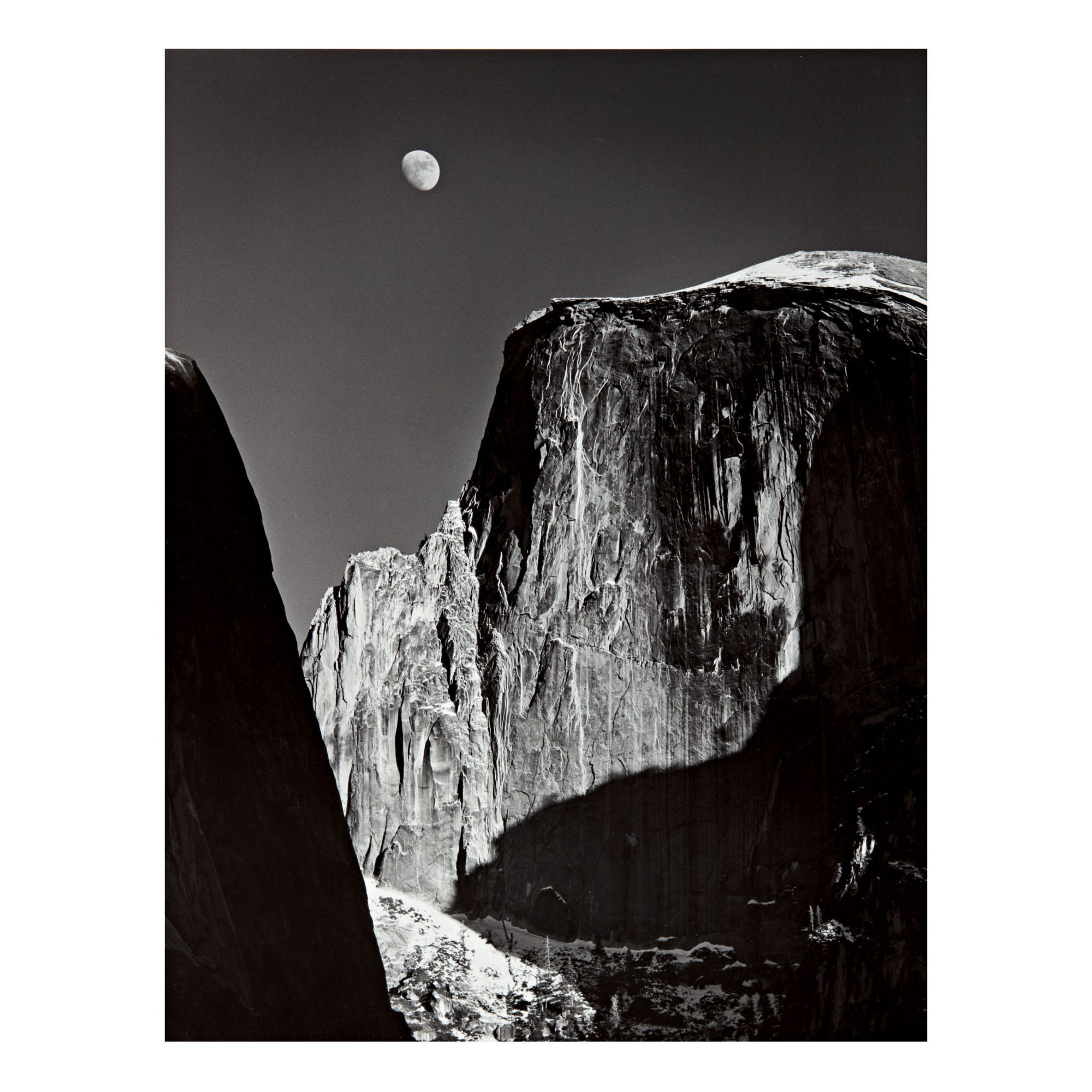
It’s just… pleasing. It looks crisp and sharp. It captures bright snow and deep shadows with lots of nuanced details in between. It has white whites, black blacks, and a rich range of grays. That’s tonal range.
Ansel Adams took it in Yosemite in 1960 when he was 58. His age at the time matters because this picture came to be as a result of both his prior decades’ work to perfect his craft and how, late in his career, he shifted where in the process he spent most of his time… but we will come back to that.
It is a beautiful image. And Adams took it with a big-ass camera that seems so damn primitive by today’s standards. A Hasselblad V-series.
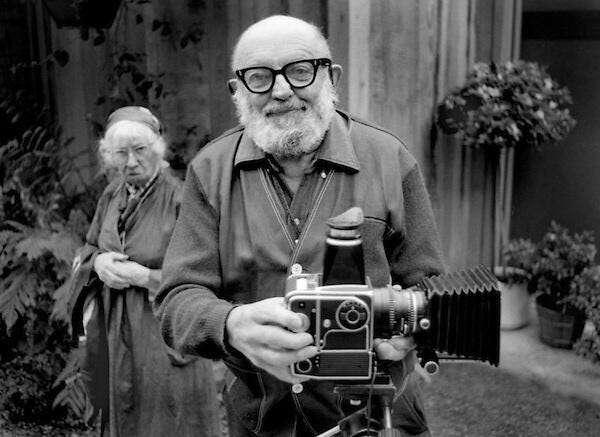
Needless to say, cameras are vastly more sophisticated. The camera I use can capture ten frames per second which are written to a memory card big enough to hold several thousand. The picture above was taken using film that came on a roll big enough to hold 12.
So, with all of these advances, how hard could it possibly be for someone to just point a modern camera like mine at Half Dome at the right time on a clear day and get the same kind of picture?
It wouldn’t be hard at all.
It would be impossible.
The reason for that is because cameras were designed to “see” the same way we do. They were modeled off of how our eyes work. And our vision happens to be not that great in ways we don’t realize.
Until incredibly recently, if you bought a decent camera, you were buying a machine that controlled how much light was let in using a mechanism that worked similarly to the way our pupils do. Inside was a shutter comprised of blades which could be made to open wider or constrict by turning a ring called an “iris”.
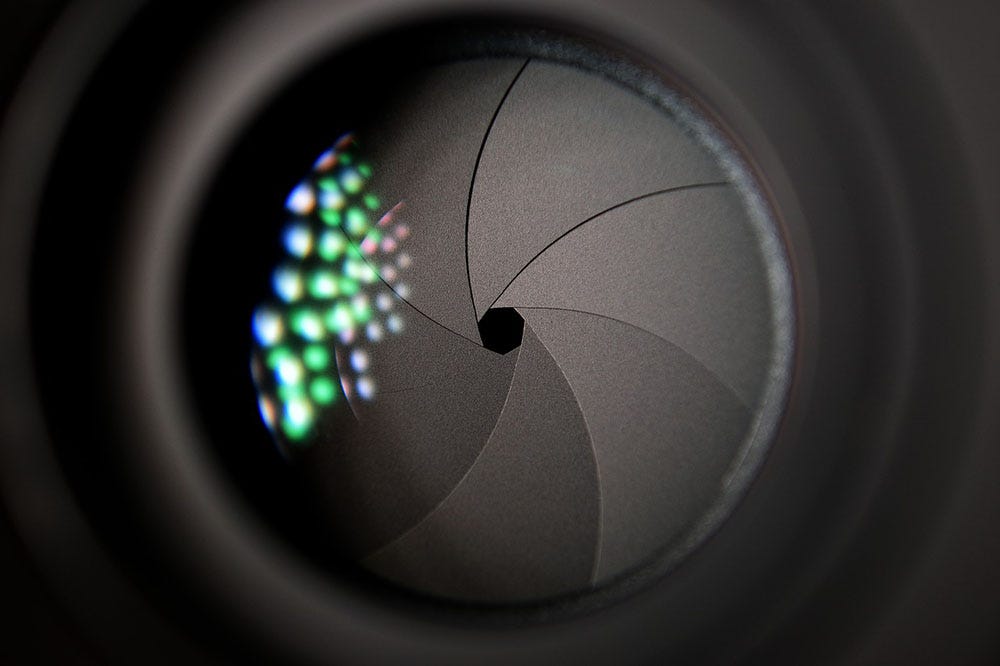
Our pupils dilate when there isn’t much light and constrict when there’s a lot so we can see whether its dawn or noon. Cameras worked the same way.
They were designed to capture what we see, so it isn’t all that much of a shock they were also designed based on how we see.
The one minor rub with that… Human vision is pretty much shit as mammalian eyesight goes. We can’t see worth a damn when it is even remotely dark or overly bright. And even in decent light, we see a far narrower range of the spectrum than other species.
Hawks can literally see the path a rodent took across a field illuminated as a visual trail from just the faint unltraviolet given off by its urine. I have to use the flashlight on my phone to read a menu.
As advanced species go, we humans don’t see particularly well.
And the reason for this is pretty damn simple:
We were not designed for this. Modern life. We were not designed for it. We were designed for conditions more like the ones humans lived in 5,000 years ago.
Back then, humans were largely diurnal. They were out and about in the daytime. And then they shut it down at night.
Humans hunted and gathered and did their things when the sun was up and then retired with the sunset to do whatever it is one does at night without electricity, a phone, or Netflix. And even when up and active during the day, during the hottest part of the hottest days (when the sun was coincidentally brightest), humans took a break to get out of the sun.
So, accordingly, human eyesight evolved to be pretty good when humans needed it most and weakest when they didn’t. It works fine in most conditions from dawn to dusk. It doesn’t work well when it is too bright or too dark.
What’s interesting (to me, at least) is that while our vision gets worse when the lights go up or down, it gets worse in two radically different ways… and that is a subject we will pick up in Part II.
(This is all leading somewhere. Stay with me.)
Your writing speaks to me, quite literally. I have no idea what your actual voice sounds like, but I feel like I could ID you in a crowd just by listening to you talk - the cadence of your writing is like listening to a master storyteller. It draws you along, pauses for emphasis, speeds up and slows down to make points, drops in register for a pithy aside, gives an conspiratoral whisper to let you in on a secret insight....in short, you weave a tale and I'm hooked!
BTW, Hoarse, I like the pattern of posting 3 parts so they are right together in my email (easy to find each one) but I can choose when I have time to read each one (which I will do when I can pay attention). If it was one big thing, I might have a harder time reading the whole thing without being interrupted. I know you've asked for some feedback about your posting patterns so I thought I'd let you know that I like this one :)