
Love Among the Violets
Part 1 Fading away, Coming to be

He was going blind.
A painter was losing his colors.
Can you even imagine? The agony that must have been...
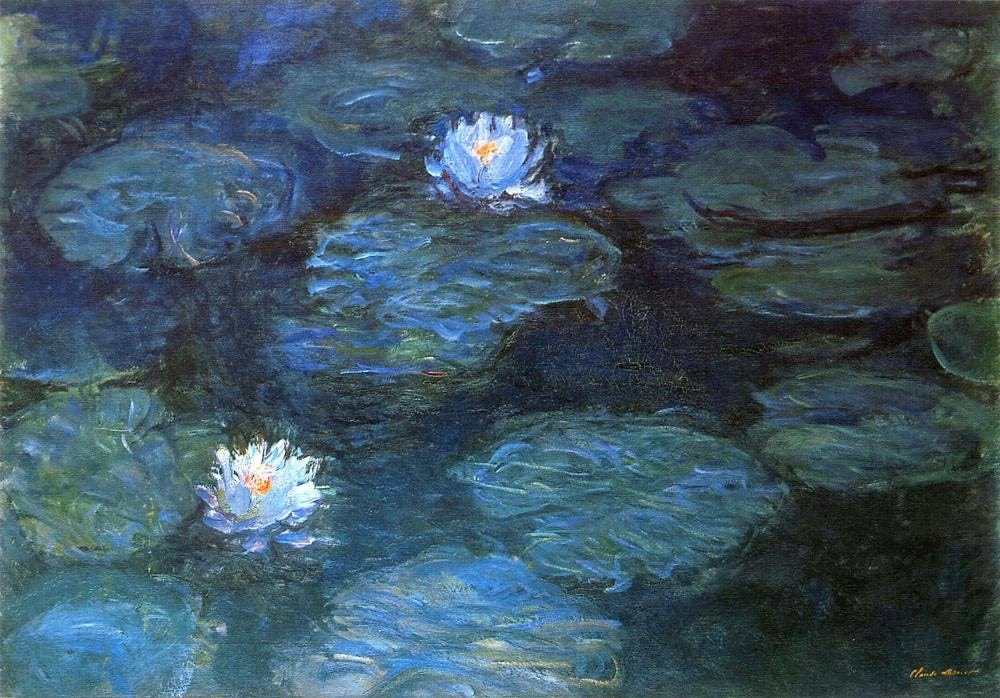
He was losing the lilies… the pond… the willows… the way their long limbs, soft in summer, reached down as if to touch the water.
He was losing the light. The way it moves, shifts, softens to gold. The glory in that, the beauty, the magic. He was losing it all.
He was losing everything.
An artist under the sun was suffering a dying of the light. The agony must have been unbearable.
How does a person survive that? How do they go on?
How does someone live without what they live for?
Claude Monet was going blind.
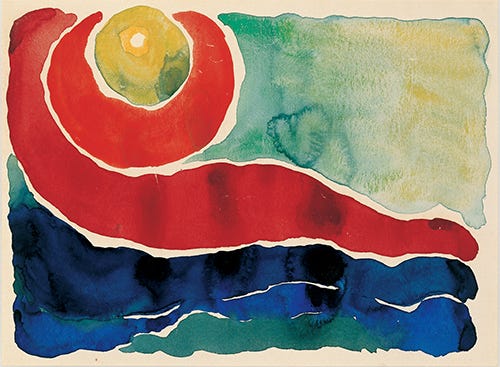
A continent away, another artist was just finding their feet - while falling into a complicated kind of love.
She loved from a post. He dangled from a wire. Both were magnetic, and so was their attraction.
I don’t know whether he suffered, but I know that she did.
All she ever wanted was to bring magnet to magnet, have them stick… have him stay. Instead, they were just two metal rings forever entwined which could neither fully align nor be pulled apart.
She just wanted to be loved, but they were two wounded people from the start.
Pain has an elemental iron. It is ferrous. We carry it in our vessels, and it is with us forever until we learn how to bleed so as to live. That is no easy feat. Until we do, the pain we carry is magnetic… and magnets attract… our pain attracts... our injuries attract. Especially the kind we suffer in childhood.
She was injured and so was he. They were both wounded but with opposite adaptations to injury. She was north to his south. In terms of compatibility, there could be no worse match. As magnets go though, none have a stronger pull.
The problem isn’t in the poles. It is in the impermanence. Her kind of magnet always holds its place. A magnet like his never does. Hers stays. His swings.
Tack one magnet to a post and hang another from a string at a distance of just, oh, so far away, the two will dance in a drama that never requites. One pulls steadily reaching for connection. The other both swings with the breeze and spins as it does. When north to south, the two draw closer. When the magnet on a string turns, that reverses. The two are now south to south - and it is the one on a string that repels away.
The magnet on a post just pulls and pulls at something it can’t reach.
The one on a wire draws in and then pushes against - always swinging either toward or away from… and in always in opposition to the other’s pull. When the two are closest and the magnet on the post is pulling most, it arcs away. When they’ve nearly escaped each other’s magnetism, it swings back. The two simply exist in a forever state of neither fully together nor fully apart.
For someone who loves from a post, there are few worse agonies than loving someone who loves from a wire.
For Georgia O’Keeffe, that person was Alfred Stieglitz.
Loving him was agony.
When Claude Monet was 55, he began to go blind. In truth, he had already been going blind for some time. It just didn’t become present for him that his vision was failing him until the age of 55.
I am 55. It has been present for me longer, but that is no matter. Claude Monet knew he was going blind at 55 and so do I. We share the same condition.
Left to run its full course, the world goes from a box of Lucky Charms with its pink hearts and yellow moons to a bowl down to only its milk. The world simply fades to winter white. It loses, first, its edges, its contrast, and then, its colors. In the end, even the mist dims.
What is left is a forever-fog that you watch roll in knowing you will never see it roll out and will never see the world through it again.
At the ages of 55, Monet and I were/are each on a slide toward someday having seen the very last of everything. The last sunrise, the last sunset, the last water lily.
Claude Monet and I were each going blind by the same age. The only difference between us is that in Claude Monet’s era, a person actually got there. In mine, a person has a procedure and is out in three hours.
In Monet’s day, the options were few and all bad. In mine, a person suffers only a brief surgery on a Monday and the world is not only back to color by the weekend, it suddenly looks like Disney painted the place – or, at least that is what I have been told.
Monet had cataracts. So do I. I’ve been aware of mine for around five years. His first reported awareness of his was in 1905 at the age of 55, but he was assuredly aware earlier. It would have been impossible for him to have not noticed the degradation. It would have been most pronounced at the times of day most precious to his work - the first and last hours of sunlight – the two ‘golden hours’. In those two windows, the long refraction of a sun low to the horizon sets the world aglow – but only so very briefly.
With cataracts, low light is bad light. The most precious hours of the day as a painter or photographer are the first ones to go. Monet undoubtedly knew before 55. I knew by 50. And given the implications in his day, that knowing likely came with a slow, rolling terror.
Cataracts themselves are a very simple condition. Within the human eye is a lens. We humans get older and so do our eyes. Our optic lenses can get a gauzy kind of clouded up in the process. At first, the world just softly, slowly, slides into a softer focus. Then it loses sharpness, shape, and saturation. Throughout, it slowly dims.
The effect is like looking through a camera lens that is slowly being turned out of focus while someone is also slowly turning down the vibrance of the scene. The color just bleeds from the picture while also blurring altogether.
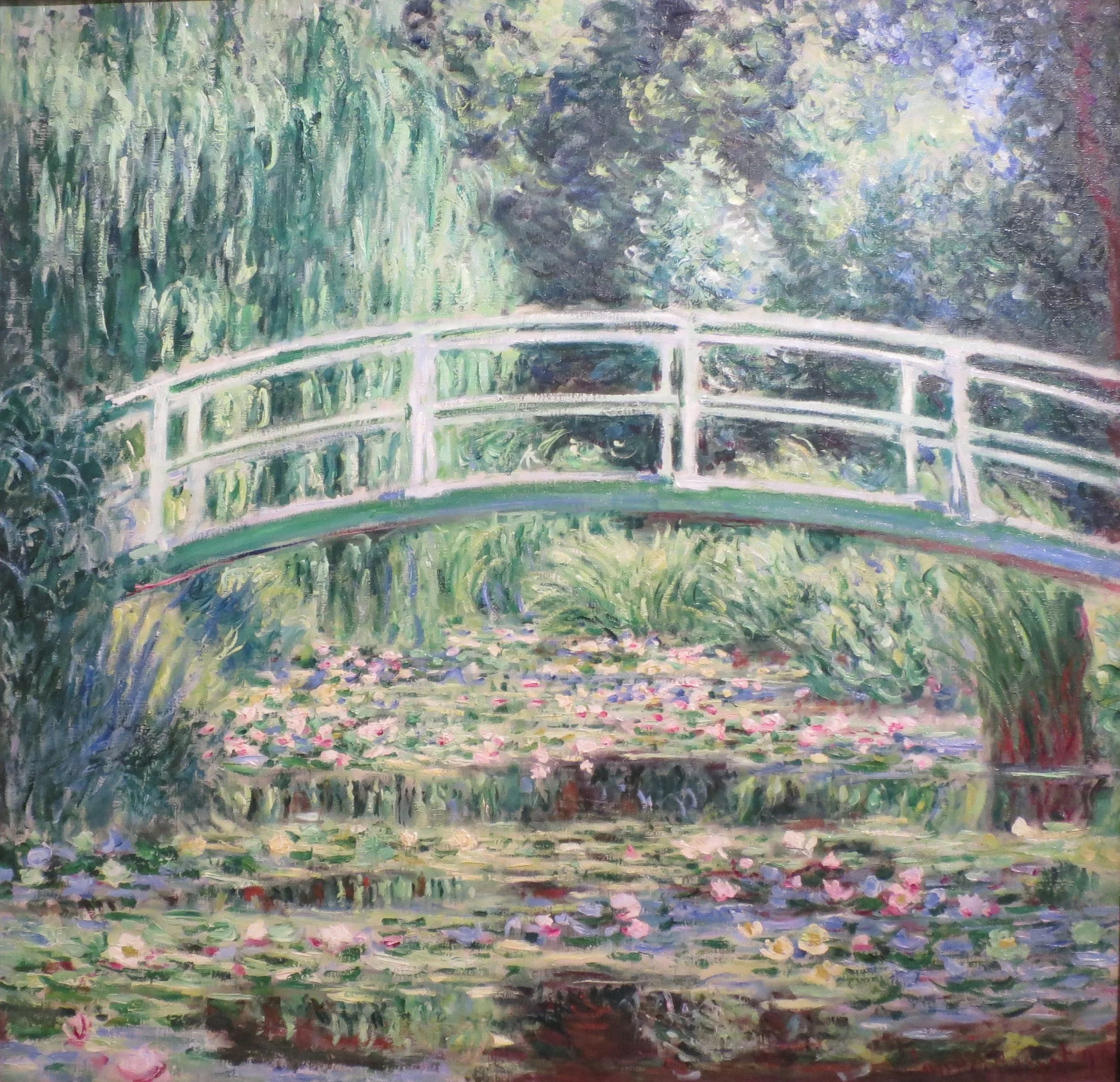
For Monet, that scene, that picture, was of Giverny – his home in the north of France – the one with the water gardens and the ‘Japanese’ bridge which the world has now seen in paintings which gavel for millions.
Monet had painted over 30 studies sitting beside his water gardens at Giverny… and they were fading right before his eyes.
He didn’t just love that place, he had willed it into existence.
He didn’t just enjoy its beauty, he created it.
The soft arc of water on a million mugs, Monet built that pond himself.
It was a marsh. It was just a reedy muck which pulled at your boots. Monet put shovel after shovel into a bog and dug down to the damn earth to create what he first saw in his mind so he could see it before him. He saw something beautiful, and then he built it so he could sit before it and paint it.
He built a placid garden of living water. A garden. Not a pond. A garden. A cultivated, careful space. An artwork of nature by an artist who loved it before it even was.
The entire pond was just slipping through his fingers… even the lilies. The precious water lilies. The soft white blossoms with their notched green pads. In summer, they lay across the water like dinner plates on a table that was always a feast. He cultivated them. He poured heart into their existence so he could see it… and now he was losing them.
I can’t even imagine the agonized suffering in their slow disappearance.
Monet’s paintings at Giverny ‘made him’ as an artist, but first he made Giverny.
Now, it was vanishing into a fog.
Someday, the water gardens he built so as to see them would be lost. That is the cruelty. That is the immeasurable theft. He was being slowly blinded to the thing he needed most in order to paint what he was always painting – and it wasn’t the pond – it was what he alone saw.
And there wasn’t a thing he could do to stop it.
Georgia O’ Keeffe was just finding her vision when Claude Monet realized he was losing his.
The year Monet realized he was going blind was the same year O’Keeffe first enrolled in art school.
O’Keeffe grew up on a dairy farm as the second of seven children. She enrolled in art school in the America of 1905 where such things were seldom done by young women…
…let alone ones from family farms in places like Sun Prairie, Wisconsin.
There was a natural geography to such places and it didn’t run farther than the folds in the map.
The world was comprised of four concentric rings: family, farm, fields, and beyond. Women served from the center. In the bullseye were daughters who became mothers and then matriarchs. Women were pillars who loved from a post. They held up the house. They didn’t stray far from it.
The world itself extended out only as far as the edge of town. Women seldom ventured out even as far as the perimeter… let alone all the way to Chicago.
Yet, there was Georgia O’Keeffe.
Fresh out of high school; alone in the city; enrolled in the Art Institute of Chicago; and on her way to being an artist.
The last of those had been the least surprising. O’Keeffe was already telling friends by the age of 12 that she wanted to be an artist. Understand her home life and it is easy to understand why. She was always going to be an artist. She didn’t become one in the classroom. She became one on the ride.
It was the trip to art lessons that first made her an artist and then took her to New York.
Alfred Stieglitz was waiting, and he had an appetite.
Up next: Part 2 – Fire and Hunger
[Becoming a paid subscriber helps keep my crazy late-life fever dream of being a writer alive. Thank you for your support. It means the world and literally keeps the lights on.]
You say it is unlike what you usually write but it's definitely your voice and your ability to tell a story, even if I don't know how it ends yet. Looking forward to the next parts.
I loved this!! You’re so talented in your writing. I love Monet. My favorite artist. I’ve colored many of his his paintings. Very difficult to do but so worth it. ❤️