
Character is Destiny
Lt. Robert C. Parsons of Beverly, Mass. - Part 1

The top panel was the first clue.
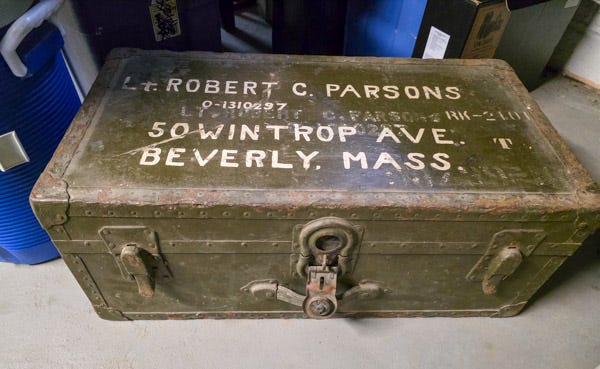
If you look closely, the neat lettering with “Lt. Robert C. Parsons” and his address weren’t the first words painted onto the trunk.
At some earlier point, only his name and serial number had been painted on.
That said something: this wasn’t a trunk scavenged by a soldier at the end of their deployment to ship their things home; it was issued for use during their service… and that just didn’t make any sense.
Someone from 50 Winthrop Avenue in Beverly, Mass. had no business with an enlisted officer ranking and a trunk that traveled with them. Boys from Beverly were cannon fodder not company officers. That was just the way of things.
To understand why that is, you have to know something of Beverly circa the 1940’s - and to know of that, you have to first know something about the history of Massachusetts, New England, and the United States altogether circa the Industrial Revolution.
From the 19th century through the early 20th century, the United States was a country bursting into boom on the backs of a growing appetite for goods, goods, goods. While manufacturing would eventually migrate inland, for a time, that appetite was largely fed by factories in New England. Where there were rivers, there was power for mills. Where there were mills, there was manufacturing. New England had plenty of each – rivers and mills.
By the late 1800’s, a well-heeled family from New York north could scarcely furnish a home without a parlor full of things from factories in Lowell, Haverhill, or Waterbury - and when it came to their actual heels – the ones on their feet - it was nearly certain their existence somehow tracked to Beverly, Massachussetts.
Beverly was once home to the largest manufacturer of machinery for the shoe industry in the country.
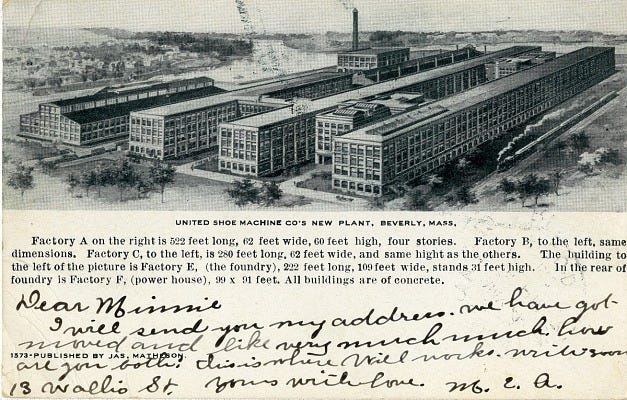
At its peak, the United Shoe Machine Corporation employed 9,000 workers. The entire population of Beverly was only 13,000. To say manufacturing dominated the town is like saying water plays a big role in the ocean. Beverly was a factory town, and so were any number of other towns in New England. Pull out a map today and trace any waterway inland from the Atlantic and anywhere you find a city today, you would have once found factories.
New England boomed on the back of the Industrial Revolution, but then manufacturing shifted inland…
and the Great Depression came along…
and Beverly and half of New England went from bustle to a suffering bust.
Hardworking families fell into a hardscrabble struggle to scrape-by. Laborers who had once produced America’s shoes, furniture, and textiles, had nowhere left to labor. The working poor simply became the poor. Hardworking families were plunged into poverty. The Parsons of Beverly, Massachusetts were one such family.
Lt. Parsons grew up in a poor area during a poor time. He was eight years old when the Great Depression arrived. Judging from the address on his trunk, he had never escaped. Google it today and you’ll find that the address on Winthrop Avenue still exists and so does the home that sat at the address almost 100 years ago when Parsons lived there. It has changed little in a century. It had no porch, no landscaping, no particular charm or curb appeal. It was simply a place to live for people who needed to live someplace.
Parsons’ family was poor and that usually led in a single direction for young men called up to the military. Poor boys like Parsons got handed a duffel and a rifle not a locker. They were issued a carbine or a garand with a heavy stock and were sent off to hell - not somewhere safe from the worst of things. They most certainly didn’t have the luxury of a foot locker which implied arrivals on docks not via a wade through seawater under fire from guns hidden in the palms.
It just didn’t make any sense.
The whole thing – the rank, the locker – it just… jangled… for me. America for all of its vaunted upward mobility and rugged individualism tends to ‘cast into caste’ its generational poor. Maybe a young man from hard beginnings eventually climbs out, but they most certainly don’t do it fresh out of high school while still living in a place the factories forgot.
Now, I will tell you, I am not a particular student of history. Researching a story like this one is by no means my ‘thing.’ I find the legwork tedious. I don’t have the time or patience for research that is slow to produce. My ADHD much prefers gratification to be of the instant variety. The idea of pursuing something over two years of slow, incremental discovery sounds quite horrible to me. There was just something about the whole ‘mystery’ of who Lt. Parsons was and how he came to be that stuck with me. I just wanted to know. There was obviously SOME reason why he had been commissioned – and reasons are knowable.
I wanted to know what they were.
So I started probing the trunk’s current owner for anything they could share. They thought they might have had some paperwork somewhere… or that there might be a remaining elderly relative they could ask. They thought that might have a uniform or other things that had been in the trunk once. Messages were sent. Calls were placed. I’d find something and send it over. That would trigger some recollection. Soon enough, things started to arrive in my inbox.
There was a registration card… and a service record… and an old panoramic picture rolled up in a tube.
With those three things, a picture of Parsons’ early life began to emerge. According to the registration card, Parsons had been working at a textile mill at the time of his enlistment. From the employer listed on the registration card, I was able to find an old ad. It was a small operation that specialized in the heavy ‘oilcloth’ gear worn by the men who fished out of Beverly Harbor.
The Northwest Atlantic is a temperamental place. It runs cold and sometimes foul. One day it might teem with cod sufficient to name an entire cape after them. Another, a Gloucester man could die of hypothermia despite the fact that it’s April and the sun is out. Men of the sea needed the right wear for the water. Parsons was a fabric cutter in a mill that made those kinds of garments.
While that made perfect sense in terms of Parsons’ bio, it still shed no light on his being enlisted as an officer. The army doesn’t give you special treatment just because you helped make rugged raincoats. His service record wasn’t of any help either.
But then there was the photo rolled up in a tube and a stroke of luck.
The weathered panoramic photo was of a Civilian Conservation Corp. (CCC) unit. Parsons was not in the company picture. I scoured every last face out of the hundred or so back and forth, over and over, and Parsons was nowhere to be found…
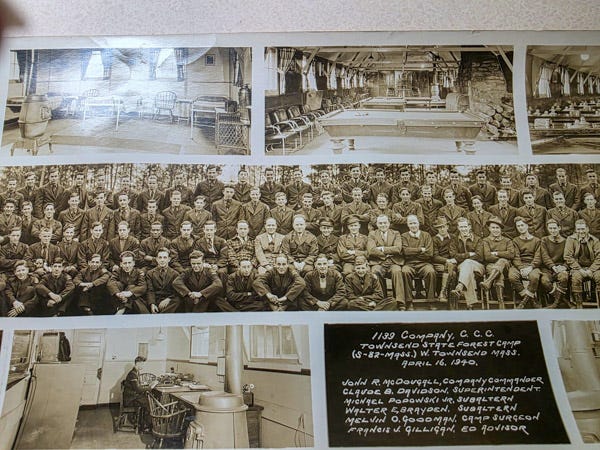
but then, in one of the insets below, there he was.
Tucked in a corner of the wide print was a single shot of a young Parsons alone at a typewriter.
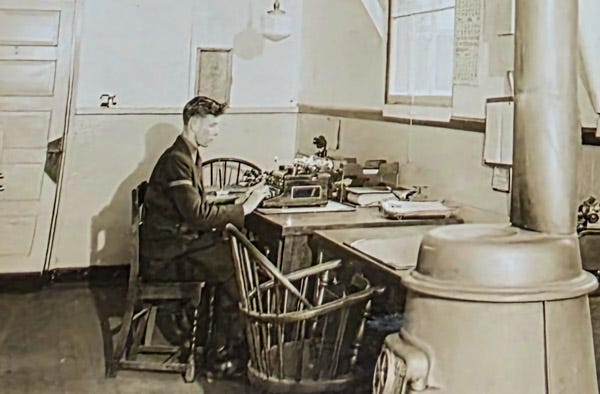
And now it made sense.
The locker. The enlisted officer ranking. The service in some non-frontline role.
It all made sense. Parsons served in the Civilian Conservation Corp, and I just happened to know a little about the CCC from having stayed in a cabin they once built with a friend who loves to regale you with the backstory on such places.
The CCC was a New Deal program designed for young men from poor families. It was ‘workfare.’ It was aimed at easing the pain of the Great Depression by making good use of idle hands. Boys from hard places were put to work for the common good. Civilian projects which would have never been planned let alone completed were conceived and seen through. Forests left to the Lorax of over-foresting were replanted. Roads were cut and camps built. Cabins went up for the public as places of recreation. Young men worked. Poor families were fed. A nation worked its way out of a crippling depression.
Boys like Robert C. Parsons were the ones in the woods.
The work was hard and physical. CCC enlistees were paid… but put nearly nothing in their own pockets. An entire month of labor netted them only $5 while the rest was sent directly home to their families. That was the deal. Parsons took it. The CCC shipped him off to the woods near the New Hampshire state line. It might have been the first time he had ever seen a forest.
Parsons didn’t have to go, of course.
There were certainly other paths.
He was young and able-bodied. He could have fled Beverly for better places with better opportunities – and ones that put the money he made in his own pocket rather than in a letter home. Instead, he went off to work for his family’s wellbeing. A son went off to help his parents. A brother went off to help his sisters. A teenager went off to a workcamp to put food on his family’s table even though he wouldn’t be home to eat.
That decision might just have saved his life.
After the United States was pulled into World War II, the army looked at callups who had served in the Conservation Corp. differently. Wars are won as much along supply lines as frontlines. The CCC was highly structured and ran on nearly militaristic logistics. Young men who had been through the program were already trained on operations. They were of more use running the war machine than as cannon fodder. Thus, factory boys like Parsons who would have otherwise gone to the front instead got commissioned into safer roles.
Parsons was assigned to a company in the South Pacific that landed when an island battle had already been decided and it was time to make a base of the place. He landed on Guadalcanal and Okinawa – two scenes of horrific fighting – but only when the worst was over and the work was more labor than combat.
That decision when he was just a teenager fresh out of high school…
Tne one where he put his family above himself…
It very well may have been the reason why Parsons made it back to Beverly after the war. There were 116 boys from town who didn’t.
Sometimes we make choices in life.
Sometimes our choices make us… our lives… our future.
Now, it is at this point where our story gains a character.
While future Lieutenant Parsons was off in the woods to take care of his family, eight hours away in Philadelphia, a young woman was just trying to take care of hers.
She was only 16. She had just lost her mother. Her younger siblings still needed one, so she dropped out of school and became one. She had been a voracious reader with an appetite for education, but children need a mother and she was the closest they had. So, like Parsons, she laid down her own hopes, opportunities, and ambitions and put the people she loved above herself.
Her name was Marjorie Bates.
By the time Parsons came home from the war, the two were in love.
Parsons came home to Beverly but didn’t stay long. There was a woman waiting for him in Philadelphia. The two had never met. They had corresponded only over the course of the war and only over letters. Nonetheless, Lt. Parsons was in love with Marjorie Bates and it was mutual. He was going to marry her… and then he did.
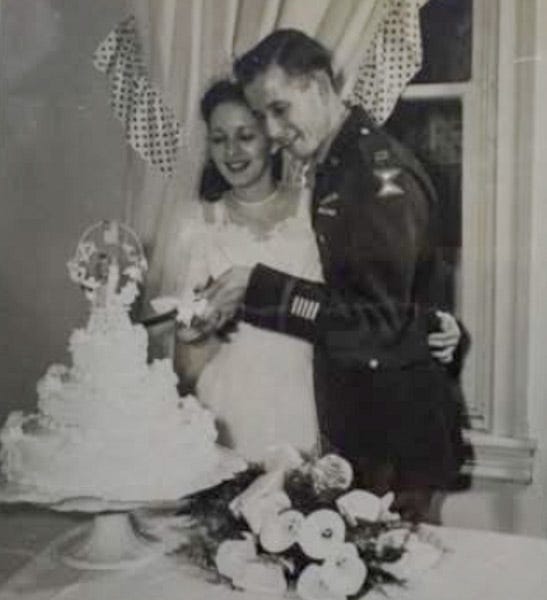
The story of how they met, well, that too begins in the Massachusetts woods.
Fate is such a funny thing.
Where our lives take us, is it ever really a matter of chance? The older I’ve gotten, the less I think so. I’ve come to think that our lives play out as dramas determined by earlier acts and the people we were then and are now. The Greek philosopher Heraclitus put it succinctly when he said, “Character is destiny.”
Parsons and Bates were two people living lives that should have never intersected, but they were two people of shared character. The boy from the textile mill and the girl washing linens, they were of the same cloth. I’d like to think that their meeting was truly destiny, that they were well and truly meant to be. That might be just my own idle romanticism, but is it so wrong to want to believe that sometimes in life, things happen because they are good and right… because good people deserve each other… and because sometimes the universe helps?
I think Lt. Parsons and Marjorie Bates were simply meant to be.
How else could they have found each other at all?
Continued in Part II to follow
Note from Mike: I could use your support now more than ever via either becoming a paid subscriber or making a one-time contribution. An annual subscription will set ya back four bucks or so a month. To offer one-time support, best options are via Zelle (hoarsewhispering@gmail.com) or Paypal (@mikegoodnough) or Venmo (@michael-goodnough-1). I am profoundly thankful for your support. It has been a long year.]
Sort of on the topic. My father in law met his bride when he was stationed at Anacostia Naval Station in DC. He was a Navy photographer, she was a "Government Girl" and both were walking with friends through Arlington Cemetery on balmy evening. A photo survived that the FiL took of the girls, all in lovely summer frocks with ribbons in their hair, off for an evening of fun in the big city. And now they had sailors to go with them! She was from a tiny farm town in western MN, he was from McKeesport PA, steel mill town then. Both joined the war effort to find a new life. Five kids, a long loving marriage, both now buried in Arlington Cemetery as close to the spot in the photo that the AC staff could find.
You are such a masterful storyteller! I am now deeply invested in the story of Lt. Parsons and Marjorie Bates…